
We all know that it is now the AI world. We can’t imagine succeeding without using artificial intelligence tools, but here comes the biggest question: how to use AI? Should we just tell AI to “write an article on an XYZ topic”?
What is the correct approach?
The difference here between generic AI output and genuinely useful output:
Context. Data. Analysis.
AI doesn’t have any understanding of your business, competitors, customers, commercial goals, and positioning, so we can’t just start with content creation or SEO optimization without giving context to it. What does the word “context” mean? It means helping the AI by telling it:
- what your business does
- what your business USPs are
- who your target audience is
- what the customer behavior is
- what the customer psychology of your audience is
- who your competitors are in your location
- what your business goals are
- what you want to achieve from a certain piece of content
If you don’t provide that information, Claude has to work with whatever limited context is available.
That often produces content that is technically coherent but strategically generic.
What Are the Best Practices for Using Claude for SEO?
| Best Practice | What to Do | Why It Matters |
| Give Context | Share your business, audience, offer, market, and goals. | Get relevant output. |
| Use Real Data | Provide keywords, analytics, competitors, and content. | Avoid guesswork. |
| Analyze First | Assess intent, gaps, and structure before writing. | Build better content. |
| Use Structure | Request tables, scores, briefs, and checklists. | Make insights actionable. |
| Add First-Party Insights | Include customer data, reviews, cases, and expertise. | Create differentiated content. |
| Keep Humans Involved | Review strategy, accuracy, and expertise. | Maintain quality and trust. |
| Verify Claims | Fact-check data, quotes, research, and key claims. | Prevent costly errors. |
The first three deserve special attention.
- Give Claude Context: If we don’t tell Claude what our business does, who our customers are, and what our objective is, then Claude will only do the guesswork.
- Use Real Data: Give Claude the actual information, such as competitor research, keyword exports, Search Console data, existing content, and customer questions.
- Analyze Before Generating: Begin with the result in mind and determine what you want to accomplish from that task.
What Happens When You Give Claude More Context?
Consider two prompts.
Generic prompt
Write a 2,000-word SEO article about healthcare providers.
You might get a perfectly readable output.
But it doesn’t know:
- Where you serve, in India or in the US?
- Whether you are trying to attract more clients or just provide information
- Whether you are a certified doctor or not
- How are you different from other dentists available in the location?
- What your competitors emphasize
Now consider a contextual workflow.
You give Claude:
- Your professional description
- Expertise information
- Customer pain points
- Target customers
- Geographic market
- Conversion objective
- Competitor pages
- Keyword data
- Existing website content
Then ask:
Analyze the search intent, content gaps, competitive landscape, target audience, customer pain points, and business opportunity before writing the content. Ask any questions if you want to before giving me the answer.
Following this process, you will get a completely different output. It will be reasoning within your business context, not merely writing.
What Context Should You Give Claude for SEO?
The context type depends on the task you are doing. You don’t need to provide every bit of information to Claude for doing all the tasks because the right context depends on the type of work you want to do.
The table below consists of a useful framework that will help you to understand what context type you need to give while doing the respective work:
| Context Type | Examples |
| Business | Products, services, goals, differentiators |
| Audience | Customer type, problems, objections, buying stage |
| Market | Location, industry, competitors |
| SEO | Keywords, SERPs, rankings, existing pages |
| Content | Articles, landing pages, brand guidelines |
| Customer | FAQs, reviews, sales conversations, support questions |
| Research | Studies, reports, documentation, first-party data |
| Conversion | Leads, sales, demos, calls, bookings |
Now the question arises: how to give context to Claude? For example, we have:
- business
- audience
- market
- SEO
- content
These are the context types. How to give that context to Claude and any other AI tool?
How to Give Claude Business Context
Using any AI tool for business and workflow is like introducing a new employee to your business. Before asking the new employee to develop an SEO strategy for your business, you must tell the new employee about your business. You will provide the following information to Claude to give it your real context
- Company name
- Products or services
- Target market
- Ideal customers
- Primary revenue sources
- Main conversion goal
- Geographic areas served
- Pricing model where relevant
- Major customer problems
- Competitive advantages
- Prioritized products or services you want
For example, instead of:
Create keywords for my website.
Provide:
We are a US-based digital marketing company serving almost all kinds of niches. Our services include SEO, guest posting, link building, and content writing. Our highest-value service is link building and guest posting. We want to generate qualified quote requests from healthcare providers and doctors.
In simple words, giving business context to Claude means giving an idea about what is commercially relevant for your business. It is because if we don’t provide our entire information (vision, mission) to an AI tool, it can provide us with high-value topics which might be commercially weak for your business.
How to Give Claude Audience Context
Sometimes we overlook the people behind keywords and tend to concentrate more on keywords only. We need to keep in mind that SEO is not really about keywords, so to target the audience, our AI tool must know the following:
- Who buys from you
- What they already know
- Their goals
- Their biggest problems
- Their concerns
- Questions they ask before purchasing
- Their objections
- Their buying stage
- Their level of expertise
For example, a health insurance form might have an:
- Audience: Ages 35 to 50, as their main target.
- Problem: Worried about unexpected healthcare costs during medical emergencies.
- Objection: Claim rejection
- Buying concern: They don’t know which health insurance plan would be the best for them.
The context changes the content strategy because different health insurance firms might be facing different buying concerns for their target audience.
A generic article on health insurance might not serve the purpose. It might attract only a broad information topic. The important distinction is that these questions are not just “What information does the audience want?”
A more commercially useful strategy could target questions such as:
- Which health insurance plan is best for people aged 35–50?
- Which health insurance policies have the lowest claim rejection rates?
- Is a lower-premium health insurance plan actually better value?
- How do I compare health insurance plans before buying one?
How to Give Claude SEO Data
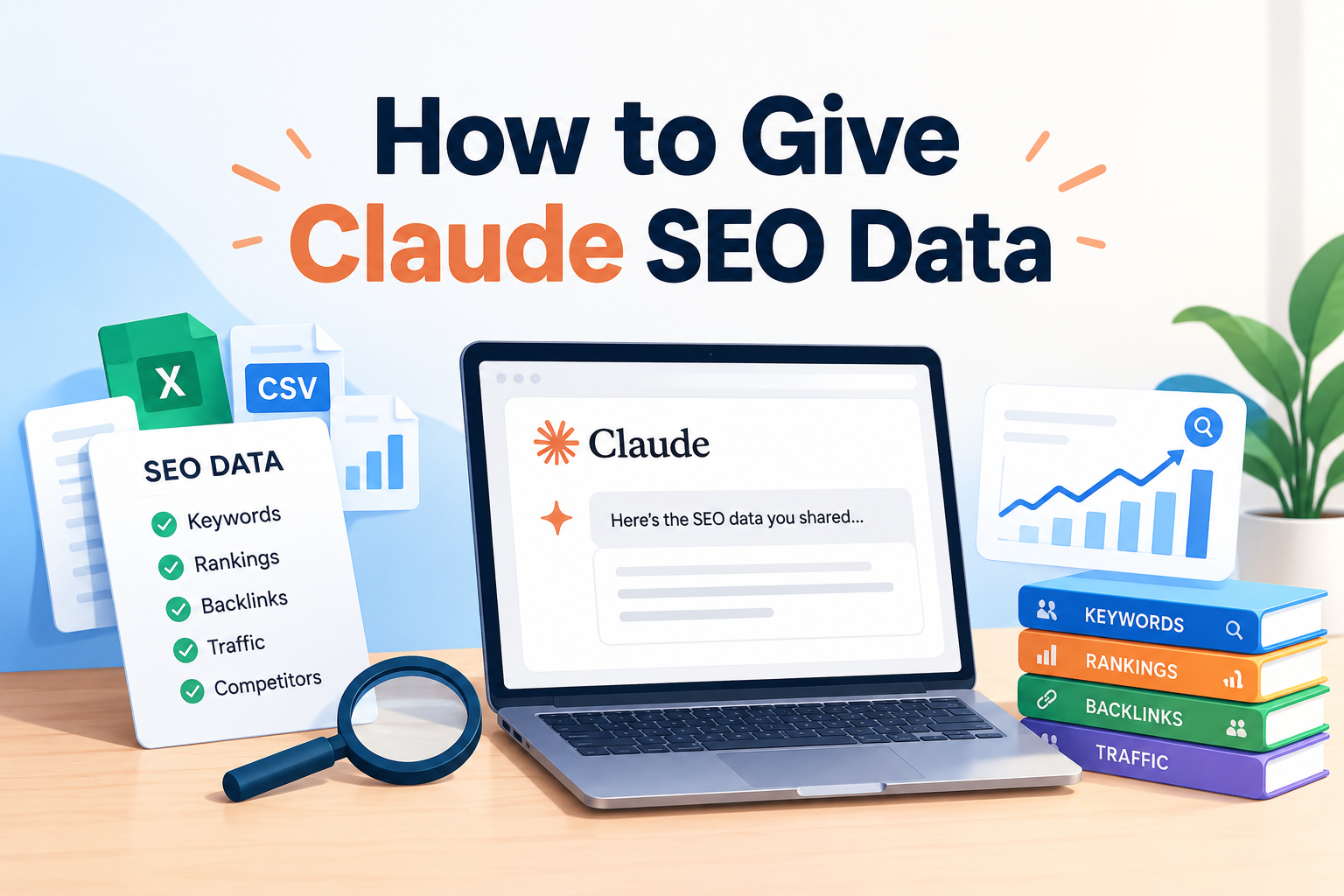
If you already have SEO data, don’t ask Claude to guess. Give it the actual data and use it to uncover opportunities.
A Simple Process
1. Give Claude your SEO data.
Rankings, search queries, keywords, search volume, SERPs, competitor data, conversions, existing content, traffic, and Google Search Console data.
↓
2. Ask Claude to analyze it
Have Claude identify search intent, content gaps, customer stage, business relevance, patterns across the data, and ranking opportunities.
↓
3. Ask Claude to prioritize opportunities
Go for opportunities that combine:
Business value + Search intent + Ranking opportunity + Traffic potential
↓
4. Turn opportunities into an SEO plan
Use the analysis to take the next action, such as:
- which pages to improve or create
- which keywords to target
- where to focus your resources
- which topics to cover
The funda here is: don’t blindly trust Claude to generate an SEO strategy or make any decisions for your business. Use it to turn your data into better decisions.
Why Should Claude Analyze Before It Writes?
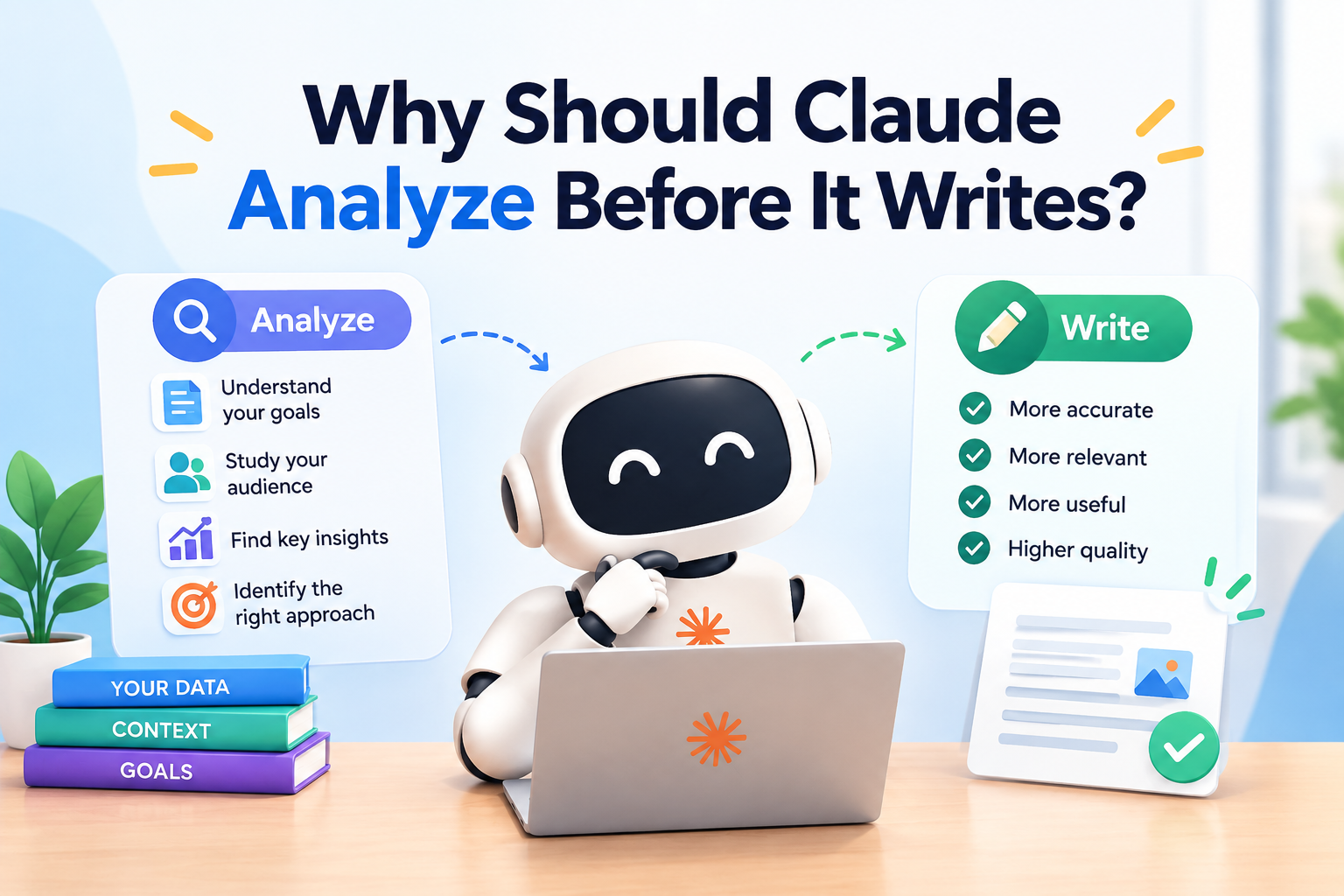
Don’t ask Claude to write first. Ask it to think first.
Instead of:
Prompt → Article → Publish
Use:
Context → Analyze → Decide → Create
For example, before writing about “best health insurance plan for a family in the USA,” ask Claude:
“What does this customer need to know before they are ready to make a decision?”
| PROMPT: You are acting as a market research and content strategy analyst helping me understand buyer psychology for [PRODUCT/SERVICE NAME]. CONTEXT: – What we sell: [1-2 sentence description] – Target buyer: [role/title, industry, company size, or demographic] – Price range/commitment level: [e.g., $X/month, one-time purchase, long sales cycle] – Main competitors or alternatives: [list 2-4, including “doing nothing” if relevant] – Existing content we have: [list URLs or page titles, or say “none yet”] TASK—please produce the following as separate labeled sections: 1. BUYING CONCERNS: What does this buyer worry about before purchasing? Separate into functional concerns (does it work, will it fit my needs), financial concerns (cost, ROI, risk), and emotional/trust concerns (credibility, reputation, fear of a bad decision). 2. DECISION FACTORS: List the top 8-10 factors this buyer actually weighs when comparing options, ranked roughly by importance. For each, note whether it’s a “must-have” (deal-breaker if missing) or a “nice-to-have” (differentiator). 3. COMMON OBJECTIONS: Role-play this buyer being skeptical. List their top 8-10 objections to choosing us, phrased in their own voice (e.g., “This seems too expensive for what it does”). 4. QUESTION LADDER: Generate 15-20 real questions this buyer would search or ask at each funnel stage — awareness (broad/educational), consideration (comparison, “how does X work”), and decision (pricing, guarantees, implementation, “is this right for me”). 5. CONTENT GAPS: Based on the existing content I listed above, flag which of the above questions/objections are NOT currently addressed anywhere in our content. 6. AEO-READY OUTPUT: Take the top 10 highest-priority questions from #4 and #5 and rewrite them as FAQ-schema-ready pairs: a clear question-format header, followed by a concise, answer-first response (2-4 sentences) optimized to be cited by AI answer engines like ChatGPT, Perplexity, and Gemini. Be specific and realistic; avoid generic marketing speak. Write as if you’ve actually researched this buyer, not just guessed.realistic—avoid |
That is where AI-assisted content starts becoming commercially useful, not just well-written.
Tip: Paste in any real sales call notes, support tickets, or reviews you have to give real signal to LLMs.
How to Use Claude to Fix Old Pages
You don’t always need a new article — sometimes you just need to fix one.
Give Claude a live page and ask:
Does it answer what people are actually searching for? → Intent check.
What’s missing? → Gap check.
Is it organized well? → Structure check.
Can readers find the answer fast? → Clarity check.
What claims need more proof? → Evidence check.
What do we offer that others don’t? → Differentiation check.
Is there a clear next step? → Conversion check.
Think of Claude as your editor, not just your writer.
Do you want to become an AI-cited source?
What Should Claude Not Do for Your SEO?
Claude is powerful—but some tasks still need human judgment or dedicated tools.
| Don’t | Do instead |
| Trust Claude for SEO metrics | Use real SEO tools |
| Publish drafts as-is | Review for accuracy & intent |
| Scale content blindly | Publish with purpose |
| Fabricate proof | Use real stories & data |
| Skip review | Keep a human in the loop |
Frequently Asked Questions
1. Can Claude write SEO-friendly content?
Yes, Claude can write SEO-friendly content, but you must make sure that you don’t publish raw AI output. Consider Claude or any other LLM as your editor, not a writer.
2. Can Claude help with AEO?
Yes, Claude can help you make content by giving direct answers to the questions, writing clearer content, adding useful information to it, and using evidence to support it, but it cannot guarantee any position in the AI search engine.
3. Can Claude guarantee Google rankings?
No LLM can guarantee you Google rankings. Claude can help you with content strategy optimization and keyword research, but rankings depend on competition, authority, technicality, your relevance, content quality, and other factors.
4. Should businesses use Claude to write all their website content?
Businesses can write their website content using any medium, but they must ensure that the business content provides expertise, experience, authoritativeness, and adds original information to the customers.