
How Is Answer Engine Optimization (AEO) Different from Traditional SEO?
Search Engine Optimization (SEO) has worked on a linear ranking algorithm over the past two decades. The goal was simple: to get a user to click the blue link and visit your website. FOr that SEO executives to build backlinks, create on-page and off-page SEO strategies, writers place keywords in specific locations to get their pages crawled.
Answer Engine Optimization (AEO) operates on a completely different model. When a user types a query, AI retrieves and extracts the answer from different pages and forms them into a single response, and provides the citations and the reference list. It does not just present a list of links; it crawls the web in real-time. Large Language Models (LLMs) like ChatGPT, Gemini, Perplexity, and OpenAI Search use Retrieval-Augmented Generation (RAG).
How Do RAG Systems Decide Which Content to Cite?
There are millions of sources on the web on the same topic. How do the LLMs pick their sources? It all depends on the content. Your content must satisfy an extraction algorithm followed by LLMs. They look for high-density and structured sections over conversational prose.
What Rules Do RAG Ingestion Systems Follow?
If you don’t do the following, the RAG model will pass over your page and cite a competitor.
- The content must present clear data and facts.
- Avoid writing fluff or creative metaphors.
- Make the beginning of the article crisp.
What Is Information Gain Scoring?
Google’s algorithm analyses a page based on the parameter of how much new, unique, and verifiable information your page adds to the already existing articles on the same topic. It is called an Information Gain Score. Most of the content on the internet is a paraphrased and recycled version of other articles. So, the value you can add to the already existing page is your Gain Score.
What Is a Factual Vacuum, and Why Does AI Ignore It?
A factual vacuum occurs when an article uses a lot of fluff. AI models are trained to focus on the direct answer to the user query and ignore the fluff phrases.
AI Evaluation Example: How AI Judges a Marketing Blog Post
To understand what AI search engines prefer, let’s compare two versions of a marketing blog introduction. One contains generic, low-value content, while the other provides structured, information-rich content that AI systems are more likely to cite.
| Evaluation Parameter | 🔴 High Factual Vacuum (Rejected by AI) | 🟢 Zero Factual Vacuum (Cited by AI) |
| Content Copy | “In today’s fast-paced digital climate, writing the best content is significant to get incredibly smart marketing results. Artificial Intelligence is also changing the ways in which content is shown on the internet. Now, the ways of showing results on the SERP have changed. Every Indian brand should look into. If you are looking for the best strategies, then this blog post will help you through it.” | “AI engines utilize Retrieval-Augmented Generation (RAG) to source data. The systems convert text strings into mathematical vector embeddings, ranking sections based on semantic distance rather than simple keyword density.” |
| Data Density | 0% — Contains no unique data points, technical concepts, or specific named entities. | 100% — Includes precise engineering terminology and clearly defined technical concepts. |
| RAG Ingestion Status | Skipped — Passed over due to low informational value and excessive filler content. | Selected for Citation — Easily converted into vector embeddings and extracted as a direct answer by AI systems. |
| Core Intent | Attempts to engage readers with generic, conversational language. | Answers a specific query using structured, factual, and information-dense content. |
How Can Original Internal Data Improve Your Gain Score?
Analyze internal company metrics, conduct surveys within your organization, and publish the results. It will give you a new point and POV to mention in your content and write about, which nobody else has written.
Why Do Expert Insights & Specific Named Entities Increase AI Trust?
While conducting the surveys, also conduct interviews with industry experts. Include their verified insights with their official credentials.
Use exact tool names, legislative acts, and dates, and concrete metrics instead of using vague approximations.
How Should You Structure Content for AI Retrieval?
To be cited by AI, your content must be extractable by RAG systems. So, ensure that you arrange your content into sections using a strict three-tier inverted pyramid model.
What Is the Three-Tier Inverted Pyramid Model?
With this model, the most important facts are written in the beginning or within the first few seconds of the landing page.
What Is an Answer Capsule, and Why Is It Important?
It is Tier 1, the top layer of the pyramid.
Conversational user questions should be formatted as H2 and H3 headings. Then provide the exact answer to that conversational question in just a 40 to 60 word answer capsule.
Earlier, we used to write transition sentences or introductory fillers. But now AI models rank the content that states the answer directly and clearly.
Important tip: Bold the primary entities and core actions so the AI can map the relationships instantly.
For example:
At Digital Brains Tech, our team executes technical SEO audits and builds high-authority backlinks for all kinds of businesses to increase monthly organic revenue.
How Should You Present Data for Maximum AI Extraction?
Data & Extractable Validation is the Middle Layer, i.e., Tier 2. It is time to structure the rest of the content. Convert complex ideas into clean Markdown tables, parallel bulleted lists, or numbered step-by-step processes.
After stating the core answer, back it up with structured data.
Where Should You Place Context, Nuance, and Expert Advice?
Context & Nuance is the Bottom Layer, i.e., Tier 3.
Sometimes, we make the mistake of mentioning the deeper context and nuances in tier 2. But
Mention them only in the final part of your section.
- List edge cases
- Mention legal disclaimers
- Share expert advice
Mention all in the final section of the content. It is like guiding the AI models to pull content from tier 3 for deeper and more complex user prompts.
Which Content Formats Are Most Extractable for AI?
Write in clear structural patterns. AI engines prefer using that content. It is a significant way to write ‘extractable’ content for AI models. Format your on-page elements to match those layouts.
a. Why Should You Use Markdown Tables?
When comparing strategies, plans, or products, use markdown tables and avoid writing long comparison paragraphs. AI search engines build their own comparison widgets and scrape web tables.
b. What Is the Parallel Bullet Framework?
When mentioning features, reasons, or steps, use parallel bullets. Start each bullet point with a 2 to 4 word bolded summary key, followed by a single explanatory sentence.
- i. How Can Predicate Precision Improve AI Understanding?: Use clear, verifiable metrics, such as Digital Brains Tech, which are the best professional seo services in the USA, rather than vague marketing adjectives.
- ii. Why Does Canonical Uniformity Matter?: Use identical names for your core products and services across your entire website.
- iii. What Is Structured Chunking, and Why Does AI Prefer It?: To optimize semantic parsing, break text into small chunks and digestible fragments.
Why Are Schema Markups Essential for AI Search?
Till now, we’ve seen how to structure and write the content. But alone it is not sufficient. Schema Markups are equally important to enhance ratings in search and win AI citations. AI is more likely to trust your page when your backend code explicitly defines your data. Then it is more likely to cite you as a source.
- How Does JSON-LD Help AI Understand Your Content?: Adding JSON-LD Schema Markup to your site’s backend gives AI engines a clear, undisputed map of your content.
- How Does Schema Reduce Algorithmic Guesswork?: It removes any ambiguity, allowing AI crawlers to index your data with complete accuracy.
- How Does Schema Complement On-Page Content?: While formatting your on-page text correctly is essential, schema handles the backend translation for search engines.
Below are the live, active script blocks that are injected into this page metadata right now, allowing AI engines to parse this guide with 100% data extraction accuracy:
<script type=”application/ld+json”>
{
“@context”: “https://schema.org”,
“@type”: “FAQPage”,
“mainEntity”: [{
“@type”: “Question”,
“name”: “How do you optimize web content for AI search engines?”,
“acceptedAnswer”: {
“@type”: “Answer”,
“text”: “Optimize content for AI search by implementing a 3-tier inverted pyramid structure, placing a direct 50-word answer capsule below question-based headings, using structured markdown tables, and injecting valid JSON-LD schema markup.”
}
}]
}
</script>
<script type=”application/ld+json”>
{
“@context”: “https://schema.org”,
“@type”: “HowTo”,
“name”: “How to Verify Website Content Freshness for AEO”,
“step”: [
{
“@type”: “HowToStep”,
“name”: “Audit Factual Metrics”,
“text”: “Review all statistics, percentages, and industry data points on the page to ensure they match current market realities.”
},
{
“@type”: “HowToStep”,
“name”: “Update JSON-LD Timestamps”,
“text”: “Modify the dateModified field inside your page’s schema code to match the exact day of verification.”
}
]
}
</script>
How Can You Become a Preferred Source for AI Search?
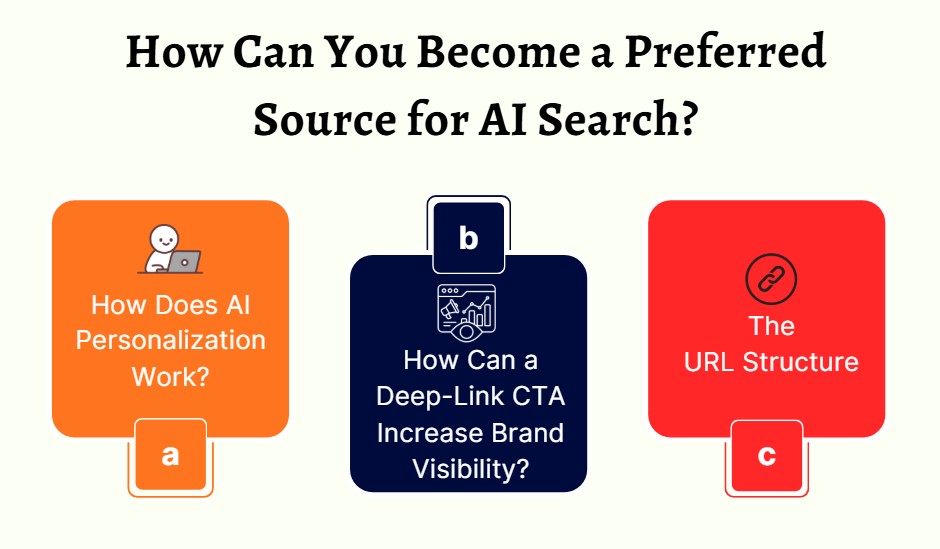
You’ve secured an AI citation, now what’s next? You should reach within a user’s personalized AI ecosystem by establishing your brand as an official Preferred Source. Tools such as Claude can also help SEO professionals analyze search data, identify content opportunities, and develop more effective optimization strategies. Learn more about Claude AI for SEO and how it can support your SEO workflow.
a. How Does AI Personalization Work?
When a user likes the AI results, they can choose to save, “star,” or follow their favorite websites. According to Google’s personalization data, a source is considered a trusted source when a user marks it as a Preferred Source. It is twice as likely to be selected for future search answers.
b. How Can a Deep-Link CTA Increase Brand Visibility?
Do not hide your follow prompt in your website footer. Use Google’s direct personalization deep-link asset to make it as easy as possible for users to favor your brand.
A deep link is a specific URL that opens a user’s private Google Account preferences with a target company’s domain pre-filled. Add a prominent call-to-action box directly below your most helpful information sections.
c. The URL Structure
The technical configuration for the deep-link uses this query parameter structure:
https://www.google.com/preferences/source?q=yourdomain.com
How Can You Audit Your Website for AI Readiness?
It is equally important to check the current health status of your website’s readiness for AI search engines. Score as follows-
0 Score: Feature is missing or unoptimized.
1 Score: Feature is partially implemented but contains structural gaps.
2 Scores: Feature is fully optimized and conforms to all AEO guidelines.
How Should You Score Your AI Readiness Audit?
Use the following checklist to evaluate how well your content is optimized for AI search engines, Answer Engines, and Retrieval-Augmented Generation (RAG) systems.
| Evaluation Checklist Item | Your Current Score (0–2) |
| Heading Structure – Every H2 and H3 is written as a clear, conversational question. | ☐ |
| Answer Capsules – A concise, ~50-word summary appears directly beneath every major heading. | ☐ |
| Factual Density – Vague adjectives are replaced with concrete metrics, statistics, technical terms, or measurable outcomes. | ☐ |
| Formatting – Data is organized using clean Markdown tables, numbered lists, or parallel bullet points for easy parsing. | ☐ |
| JSON-LD Schema – A valid, error-free FAQPage or HowTo schema is implemented in the page backend. | ☐ |
| E-E-A-T Anchoring – The page clearly identifies the expert author, reviewer, credentials, and business or registration details. | ☐ |
| Page Performance – The page loads quickly and achieves a mobile performance score above 90 in speed audits. | ☐ |
| Preferred Source CTA – A direct personalization or consultation link is placed next to high-value tools or resources. | ☐ |
What Does Your AI Readiness Score Mean?
| Score Range | Evaluation Status | What It Means |
| 0–6 Points | 🔴 Critical RAG Vulnerability | Severe Risk. High likelihood of losing traditional organic search traffic to structured competitors.Immediate Action PlanReconstruct content blocks using the Three-Tier Inverted Pyramid model immediately.Clean up on-page formatting and deploy valid backend JSON-LD Schema Markups. |
| 7–12 Points | 🟡 Emerging Authority | Moderate Risk. Missing out on valuable AI Overview and snippet citation placements.AI engines occasionally pull data but reject unformatted sections. |
| 13–16 Points | 🟢 AI-Ready Source | Secure. Positions your brand to win consistent citations and secure Preferred Source status.Maintain a strict 90-day content freshness update cycle to hold authority. |
Why Should You Follow a 90-Day Content Freshness Cycle?
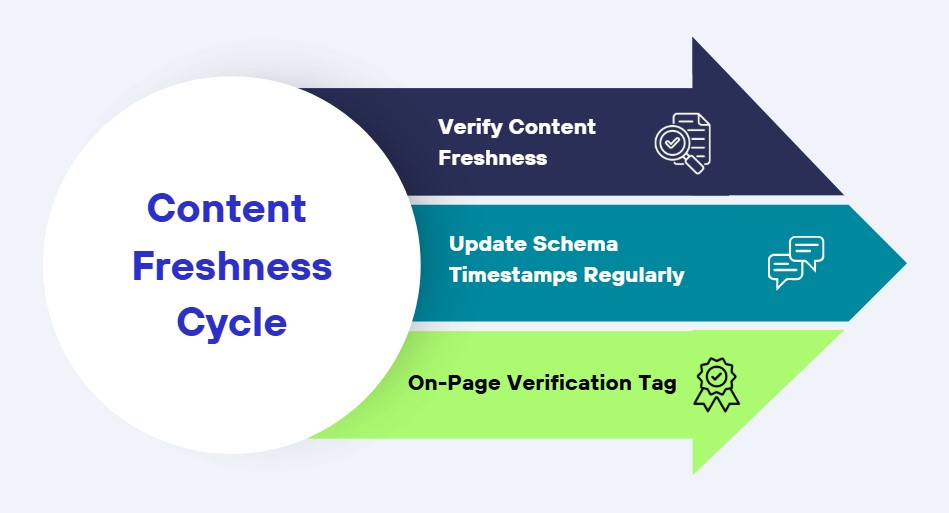
AI search engines prioritize accurate and current data. A page with updated and fresher resources will be chosen over a page with out-of-date metrics will quickly lose its citation spots to fresher resources.
- How Can You Verify Content Freshness?: Every quarter, review your statistics costs to ensure they match current market realities.
- Why Should You Update Schema Timestamps Regularly?: After verifying the data, update the dateModified field inside your backend schema code.
- What Is an On-Page Verification Tag?: Add a digital stamp of authenticity. Add a short, official statement at the very bottom of your article that explicitly states who verified the facts and exactly when they did it.
What Are the Key Takeaways for Winning AI Citations?
Winning citations in the age of AI search requires a shift from traditional keyword stuffing to structured data modeling. By organizing your content with the Three-Tier Inverted Pyramid, clearing out wordy filler text, and deploying backend JSON-LD Schema Markup, you make it incredibly easy for AI engines to extract and credit your data. Put these steps on autopilot with a 90-day automated review cycle to keep your content fresh, protect your search visibility, and secure your spot as a trusted, Preferred Source for your audience.
Frequently Asked Questions (FAQs)
1. What is the difference between SEO and AEO?
Traditional SEO focuses on improving rankings in search engine results, while Answer Engine Optimization (AEO) helps AI-powered search engines retrieve, understand, and directly cite your content in AI-generated answers.
2. What makes content more likely to be cited by AI?
AI prefers content that contains factual information, structured formatting, answer capsules, question-based headings, markdown tables, valid schema markup, and unique insights instead of generic or promotional writing.
3. What is Retrieval-Augmented Generation (RAG)?
Retrieval-Augmented Generation (RAG) is the technology used by AI search engines to retrieve relevant information from multiple sources before generating an answer. It prioritizes content that is structured, factual, and easy to extract.
4. How often should I update my content for AI search?
Review and refresh your content every 90 days by verifying statistics, updating examples, refreshing schema markup, and modifying the dateModified field to maintain citation eligibility.
5. What is the fastest way to improve AI visibility?
Start by restructuring your content using question-based H2 and H3 headings, add concise answer capsules below each heading, replace vague statements with measurable facts, implement JSON-LD schema, and improve page speed and E-E-A-T signals.