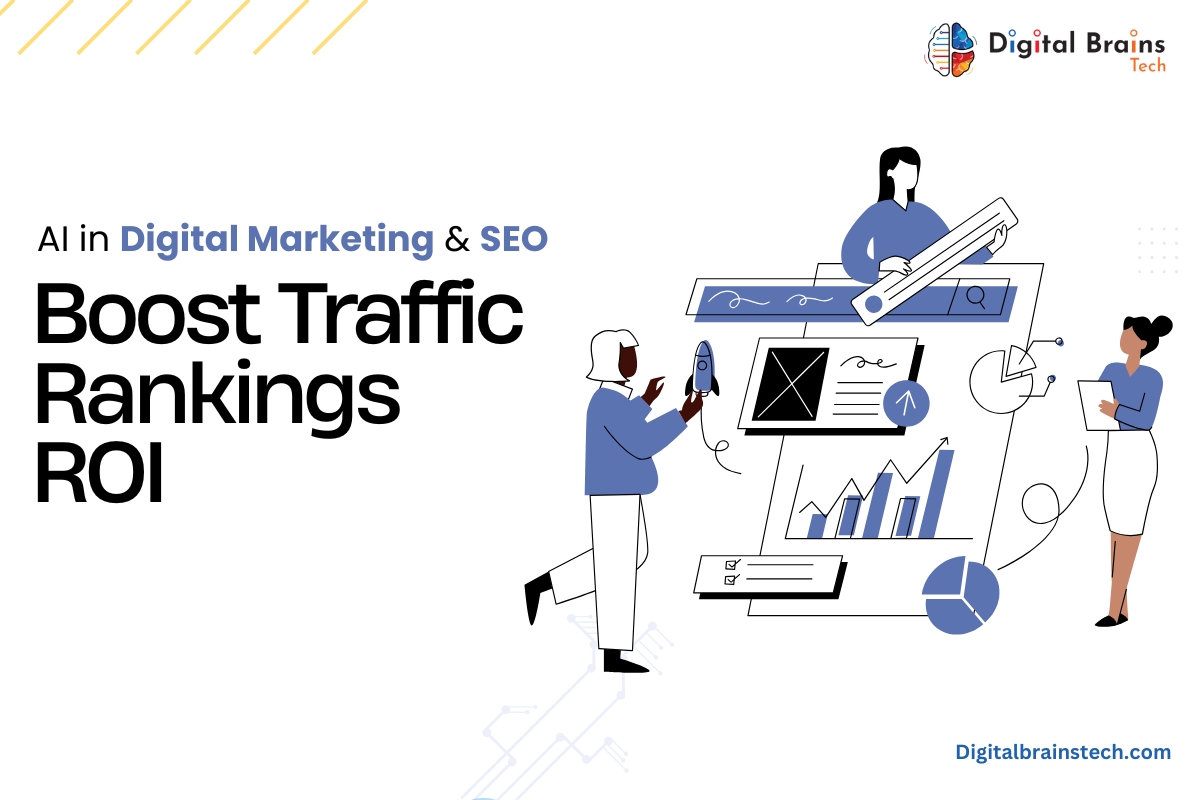
What is the true business value of AI in digital marketing?
How would you decide if you have deployed AI correctly into your business?
By having a huge chunk of “saved time?”
You need to rethink.
The true business value of AI lies in measurable performance outcomes: shorter sales cycles, higher conversion rates, and increased revenue. The core advantage of using AI is transforming raw data into predictive insights, which then further scales qualified lead acquisition and bottom-line enterprise growth. But it is only possible when your usage of AI tools is inclined toward strategic goals.
Your key motive is not just to be a part of the trend, but to attain growth and scale your business in a shorter span with minimal effort.
Have you tied your AI tools to core business outcomes?
Or
Are you just adopting it as a collection of disconnected software tools?
The goal should be AI-assisted marketing, not AI-only marketing.
What Can Be Made Easy with AI in Digital Marketing?
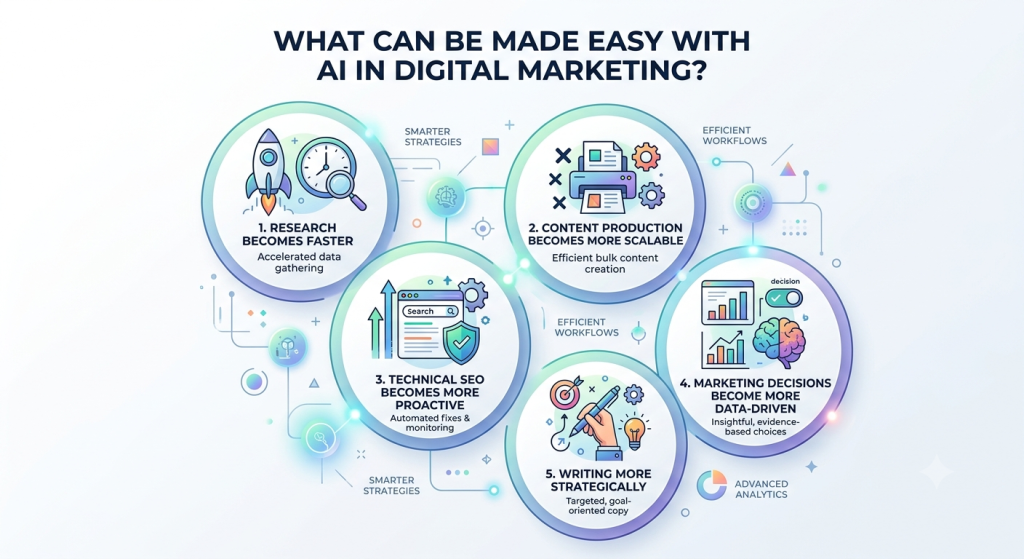
At Digital Brains Tech, we have been implementing Artificial Intelligence, and we have developed AI-assisted marketing programs. The following changes have become clear.
1. Research Becomes Faster
Our SEO executives took a substantial amount of time to conduct keyword research, do competitor analysis, and map topics. But now with AI-assisted techniques, the time has been reduced. This gives marketers more time for quality control, strategy, and content review.
2. Content Production Becomes More Scalable
With the help of several AI tools such as Perplexity, Claude, and ChatGPT, writers can now research across millions of resources, find a POV to write, and then put across a perspective on the respective topic with ease. AI helps to create:
- Outlines
- Briefs
- First drafts
- Content variations
- FAQs
- Add stories to it, but we make sure that
Thought behind the content and the perspective and human interaction is done by the writers so that the users can be connected well through the content and the best result comes from combining AI speed with human editorial judgment.
3. Technical SEO Becomes More Proactive
We have hundreds of URLs on our website, Digital Brains Tech. Now we have been using AI-powered tools to identify the problems and patterns and fix them without putting in the manual efforts and time that we used to put in earlier. Hence, our SEO problems have been solved to a great extent
AI-powered tools can help identify patterns such as:
- Redirect chains
- Broken links
- Orphan pages
- Duplicate content
- Crawl issues
- Indexing problems
- Poor internal linking
4. Marketing Decisions Become More Data-Driven
I had a conversation with the director of the company recently, and he has shared that one of the biggest and most efficient use cases of AI-powered tools he has done till now is with handling data. AI can process huge chunks of data in a fraction of a second and identify patterns that are difficult to spot manually.
This helps marketers understand what is working, what is declining, and where the next opportunity may be.
5. Writing More Strategically
For our clients, we have started using the Hub and Spoke content structure, where we write around a broad topic and support that topic with other related content.
- The hub explains the overall topic.
- The spoke pages explore individual subjects in greater detail.
For example:
Hub: AI in Digital Marketing & SEO
Spokes:
- AI-driven keyword research
- AI content creation
- AI on-page SEO
- AI technical SEO
- Predictive SEO analytics
- AI conversion rate optimization
Internal links between the hub and spoke pages also help users discover related information and create a logical website structure.
Best Strategy for Top 4 AI Platforms
| Strategy | Core Focus | Primary Goal | Key Surface / Platform |
| Traditional SEO | Keyword optimisation, technical health, & link building | Driving direct blue-link website clicks | Google SERP |
| AEO | Direct answers to clear queries & voice search | Capturing featured snippets & voice responses | Featured Snippets, Siri, Alexa |
| GEO | Brand citations, quotes, & unstructured data in LLMs | Earning brand mentions in AI-synthesized outputs | ChatGPT, Perplexity, Claude |
| Google AI Mode | Comprehensive context, semantic structure, & authoritative data | Appearing in Google AI Overviews & multi-modal AI SERPs | Google AI Search |
The Six Pillars of AI-Driven Marketing
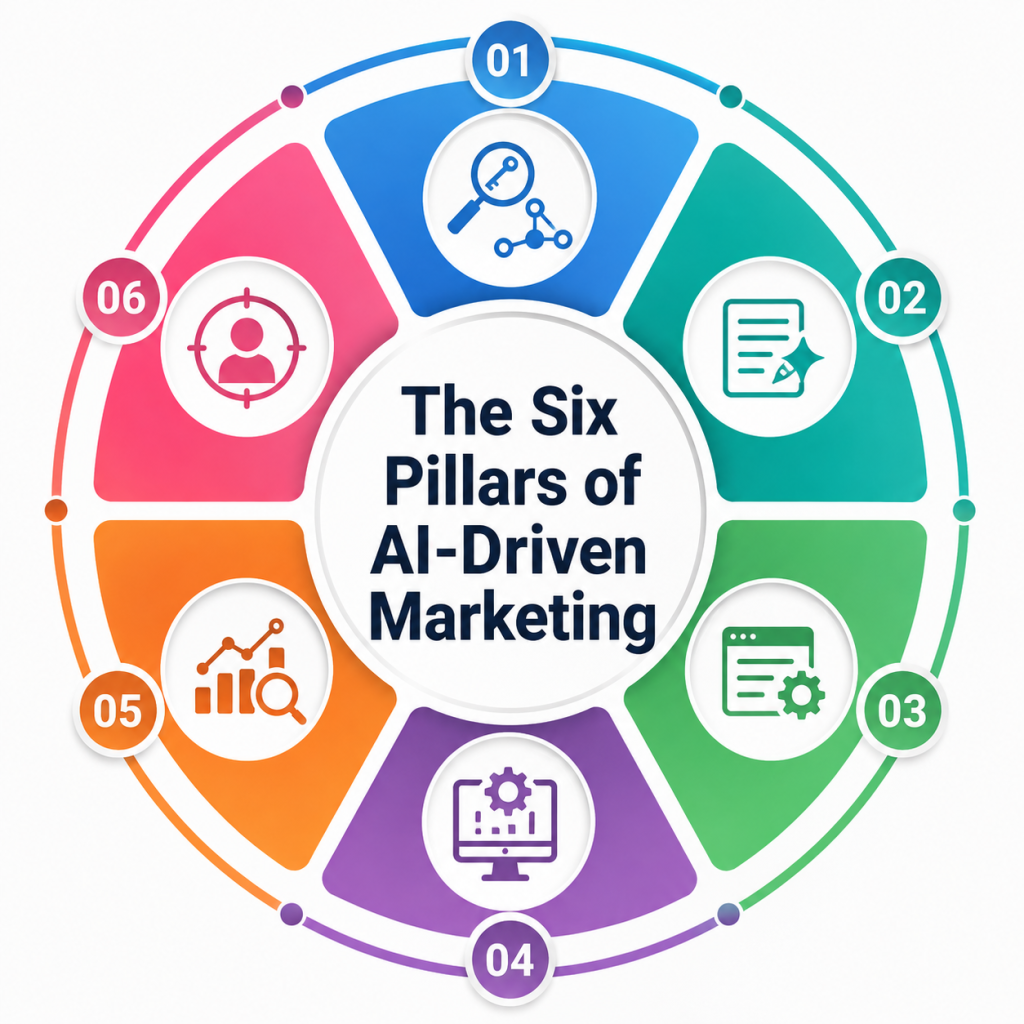
1. AI-Driven Keyword Research and Topic Clusters
Traditional keyword tools tell you what people search for.
But we need to understand why people search for those terms. It will help to go deeper into the thought process of the user and give what they are actually looking for and what AI has made possible.
It can identify:
- Search intent
- Related questions
- Semantic keywords
- Topic clusters
- Content gaps
- Subtopics
- Competitor opportunities
For example, someone searching for “AI SEO” may also want to know:
- What is AI SEO?
- How does AI affect Google rankings?
- How can AI help with keyword research?
- What are the best AI SEO tools?
- How do I optimize content for AI search?
So, to date, we have been creating separate, disconnected pages for the questions the users have been looking for, but now building a comprehensive content ecosystem can provide more value to the user. Hence, a stronger foundation for topical authority can be built
2. AI Content Creation Without Losing Quality
The world has upgraded itself to AI tools to speed up content production.
Tools such as ChatGPT and Claude can help with:
- Content outlines
- Research organization
- First drafts
- FAQs
- Meta descriptions
- Content updates
- Content variations
We have heard many companies say that we have fired the content writers and hired AI tools to write content. It is one of the biggest AI SEO mistakes. They have forgotten the fact that AI-generated content must be reviewed. Publishing the maximum possible number of articles on the website is not the objective; the objective that we follow at Digital Brains Tech is to publish the most useful content for the audience. There is a certain strategy that needs to be followed to write content.
Here is a better process a digital marketing company must follow to provide the best value to its users through content.
Research → Content brief → Human strategy → AI-assisted draft → Expert review → Fact-checking → SEO optimization → Final editing
This workflow keeps the advantages of AI while protecting content quality.
3. AI-Powered On-Page SEO
Gone are the days when repeating a keyword was the major task for On-Page SEO, but today search engines need to understand what the page is all about, what entities it discusses, and how the concepts relate to one another
AI can help marketers analyze the following:
- Titles
- Headings
- Metadata
- Entities
- Related terms
- Internal links
- Structured data
- Content gaps
At Digital Brains Tech, we identify pages that need similar on-page improvements using AI tools. Mostly, we have been doing it for publishers, SaaS companies, e-commerce websites, and other businesses with large websites containing hundreds of pages.
4. AI for Technical SEO
The major concern that you might be thinking now is that if AI can do all these, has it become very easy to replace an SEO specialist? AI is here to help specialists find problems faster and prioritize what matters most.
AI-powered crawlers and scripts can help identify problems such as:
- Broken links
- Redirect loops
- Redirect chains
- Orphan pages
- Duplicate pages
- Crawl-budget issues
- Indexing problems
- Missing metadata
5. Predictive Analytics and Search Intent
The search intent and behavior of the user change constantly. One topic that is never in the conversation today might become a strong demand to gain momentum. New trends come with great opportunities, but then you need to create content or campaigns before your competitors.
AI-powered analytics can help marketers identify changes in:
- Search demand
- User behavior
- Content performance
- Customer interests
- Conversion patterns
6. AI-Powered CRO and Personalization
The real problem with today’s SEO and digital marketing is not being able to turn the right visitors into customers. For a company, Enterprise SEO Services and SEO for Small Businesses might look like the same keywords. If a visitor is searching for SEO for Small Businesses, then they would be interested in tips for small businesses to grow in 2026 rather than enterprise-focused messaging.
AI can help to improve CRO, that is, conversion rate optimization, with the help of:
- Personalized recommendations
- Personalized website experiences
- Dynamic text
- Predictive analytics
- Heatmap analysis
- Automated testing
- Audience segmentation
AI can help identify these patterns and support more relevant experiences.
This connects SEO with the final stage of the marketing funnel:
Traffic → Engagement → Conversion → Revenue
How Do You Build an AI-Powered SEO Workflow?
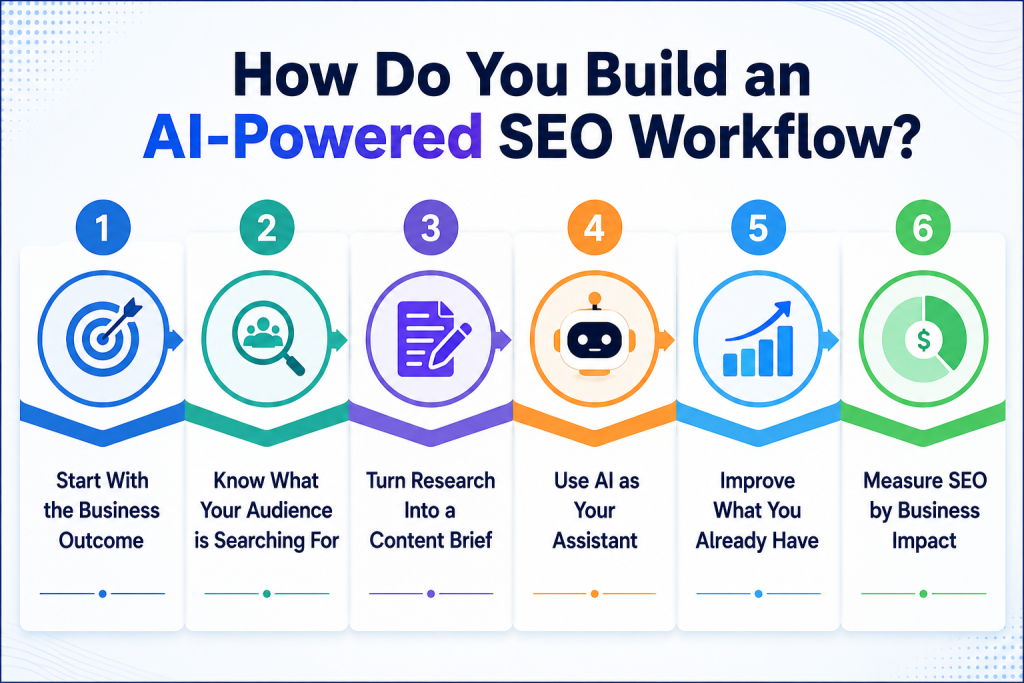
Knowing AI is not enough. Knowing how to use AI effectively for your business—that is true intelligence and wisdom.
1. Start With the Business Outcome
AI should solve a business problem—not simply produce more content.
You must know what outcome you are looking for, whether it is to have more organic traffic, qualified leads, or conversions, lower content cost, and stronger brand visibility. Choose the right business outcome and start with that.
2. Know What Your Audience is Searching For
Yes, keywords are important, but it is time to go beyond keywords. Now we must identify the search intent behind each query.
For example, we did it for one of our clients having an e-commerce store. The nearby audience has been looking for quality products. Price was not a concern, so quality was the concern. We marketed on the parameter of quality and created campaigns around them. Hence, we understood what the audience was searching for and provided them with that.
3. Turn Research Into a Content Brief
Notice that AI is coming in the third step, where we have to do research with the help of AI.
Use AI to bring together keywords, related questions, entities, competitor gaps, headings, internal-link opportunities, data points, and conversion opportunities. A good brief gives your writer a clear strategic direction.
4. Use AI as Your Assistant
You may take a sigh of relief that the most optimum and long-lasting use of AI is as our assistance. Many amateurs might be spreading a word for AI to replace humans. But we must add our human experience, our POC, examples and original insights to the research, organization, and analysis, conducted by AI to extract the real output from it.
5. Improve What You Already Have
Rather than spending time and energy on writing and publishing new articles, identify the content with hidden and untapped potential. Optimize pages, fix content gaps, update outdated content, strengthen intent alignment, and improve internal linking. Check for technical factors such as page speed, mobile experience, and structured data.
6. Measure SEO by Business Impact
SEO is not just a traffic-generation activity. Utilize it as a business growth strategy
Don’t stop at rankings. Track the complete journey: Search → Visit → Engagement → Conversion → Qualified Lead → Revenue
What Does the Future of AI in SEO Look Like?
Artificial Intelligence is here for speed, and accuracy. Its main job will be to connect different parts of digital marketing and create an (automated) system instead of separate activities.
- Keyword research
- Content creation
- Technical SEO
- Analytics
- Personalization
- Conversion optimization
But does that mean that the traditional SEO fundamentals are disappearing? NO.
Websites still need Clear information architecture, good user experience
reliable information, useful content, strong technical foundations, internal links and relevant expertise.
Then what would AI do?
AI simply makes it possible to analyze and improve these areas at greater speed and scale.
What Does This Mean for Your Business?
Do I need to invest in the most premium version of the best AI model?
In the near future, almost everyone will have access to powerful AI tools.
But the competitive advantage will not belong to companies that simply have access to the best AI model.
The ones who know how to use AI for strategy, data, expertise, creativity, and continuous testing will win.
In other words, the future of SEO is not:
AI vs. humans.
It is:
AI-augmented strategy vs. inefficient manual execution.
How Digital Brains Tech Is Leading the Way?
Our goal is to generate qualified leads, and improve business outcomes for our clients worldwide and across different niches.
Digital Brains Tech combines all the parts of digital marketing such as AI-assisted research, SEO, technical analysis, etc. AI-driven marketing is the result that produces better results than increased traffic.
We have understood that the hard part is knowing how to use AI tools and Agentic tools to produce business results. Our experts at the company are regular learners and have cracked which tools to use for certain tasks, where to use them, and how to connect them to a strategy.
Why US Companies Partner with Digital Brains Tech
AI search goes beyond traditional SEO. Digital Brains Tech helps US businesses achieve better ROI, attract relevant traffic, appear in AI-generated results, and improve search visibility.
Our key strategies include:
- GEO: Use original data, statistics, and expert insights to improve citations across ChatGPT, Perplexity, and Claude.
- AEO: Structure clear, direct answers for featured snippets and voice search.
- Technical Optimisation: Use structured data and crawler-friendly architecture to improve discoverability.
- Multi-Channel Authority: Build credible brand mentions across trusted websites, forums, reviews, and podcasts.
Final Takeaway
Digital marketing was starting to feel a little stale. AI came in and gave it a fresh makeover, not by replacing what worked, but by making it smarter, faster, and more relevant.
The real opportunity lies in systems.
The strongest teams are building connected systems where research informs content, content supports SEO, technical health supports visibility, analytics guide decisions, and conversion data improves the next round of marketing. It was never about simply publishing more content or using more AI tools.