Paid search marketing is a digital marketing strategy technique. Here, businesses pay search engines to display their advertisements on SERPs. These ads give businesses immediate visibility to potential prospects who are searching for related products or services.
How It Works
Paid search marketing works differently from SEO (search engine optimization). It operates on a pay-per-click (PPC) model, where businesses pay only when a user clicks on their ad, not just to display it.
Ad Rank
Thousands of businesses might want to showcase their ads on top for certain keywords. Then how is the sequence decided?
It is based on Ad Rank.
To determine which ads appear at the top, businesses bid on those keywords. The highest bidder does not automatically win the top spot. Instead, search engines calculate Ad Rank by multiplying the advertiser’s maximum bid by their Quality Score.
Quality Score
The quality of the ad, which includes the relevance and usefulness of the advertisement, is the Quality Score. The best PPC campaign management services offer the best quality score.
It is based on three main factors:
- Ad relevance: How closely the ad’s messaging matches the intent behind the user’s search query
- Expected click-through rate (CTR): The chance that people will click it upon seeing it. Digital marketing companies can help you improve your quality score
- Landing page experience: The relevance, load speed, and overall user-friendliness of the website page the ad links to
Key Components of a Campaign
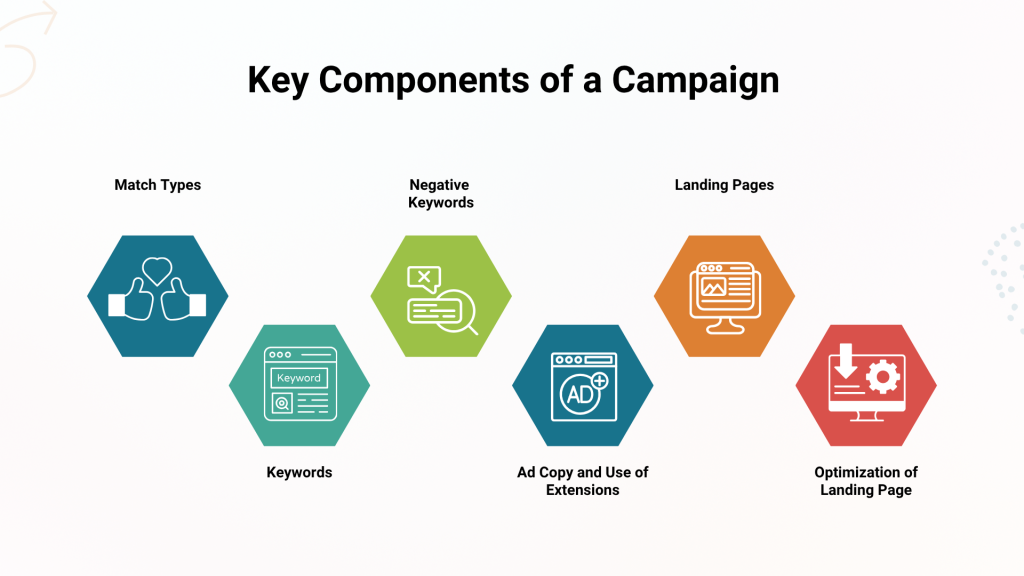
There are certain factors required to create an impactful campaign and achieve a high Quality Score and Ad Rank. Take a look at the components of a strategic paid search campaign:
- Match Types: Use of “match types” (broad, phrase, or exact) to dictate how closely a user’s search must match the chosen keyword to trigger the ad.
- Keywords: Specific search terms should closely follow the user’s search to add relevancy to the query
- Negative Keywords: Used to prevent ads from showing for irrelevant searches. They help filter out unqualified traffic and avoid wasted budget
- Ad Copy and Use of Extensions: A well-written ad contains relevant keywords, strong CTA and clear benefits. Also, it consists of location addresses, phone numbers, links to other sub-pages that can be added through ad extensions.
- Landing Pages: As the name suggests, landing pages are the pages where the user will land after clicking on the ad. So, this page must address all the promises mentioned in the ad. Also, it must include clear conversion paths to guide the user.
- Optimization of Landing Page: It is like welcoming the customer to your shop after persuading them through the advertisement. So, the page should present clear value propositions (explaining why a customer should choose a product or service). It should directly tell the customer what they gain by choosing the brand. Yes, it must load quickly.
This balance is maintained through Keyword Match Types, which define the boundaries of your targeting:
Keyword Match Types Table
| Match Type | Definition | Reach vs. Precision | Practical Example |
| Broad Match | Default type: accounts for misspellings, synonyms, and related intent. | Highest Reach | “women’s hats” may match “winter headwear.” |
| Phrase Match | Targets searches that include the meaning of the keyword. | Moderate Precision | “running shoes” may match “best shoes for running.” |
| Exact Match | Targets queries with the same precise meaning or intent. | Highest Precision | “formal shoes” matches only “formal shoes” or “shoes formal.” |
Paid Search vs. PPC vs. SEO vs. SEM
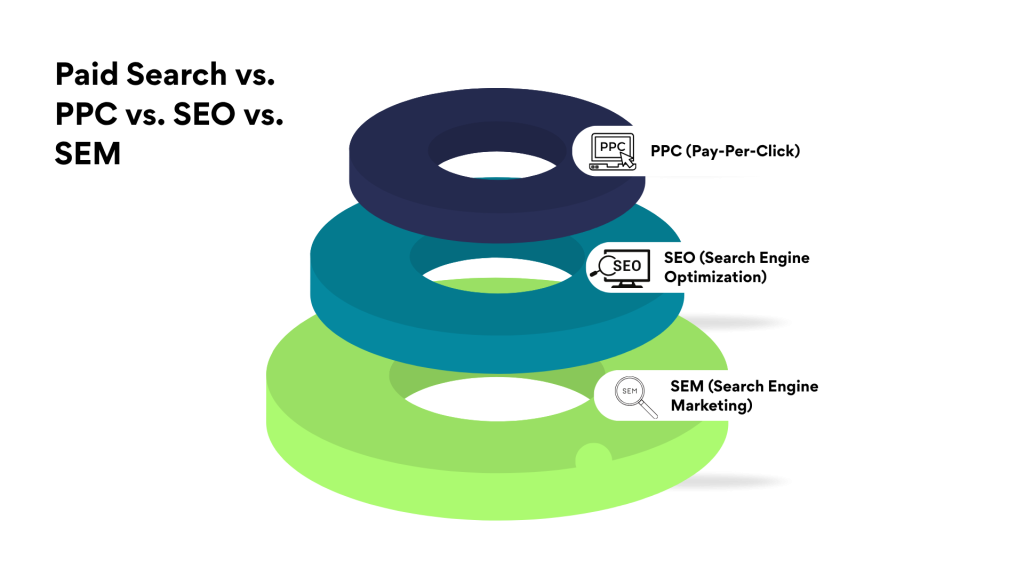
Are you amongst those who usually get confused with these marketing acronyms? You are not alone. All these have distinct meanings and differences.
- PPC (Pay-Per-Click): You pay for every click on your advertisement. While paid search is limited to search engines, PPC also includes platforms like Facebook and other display networks.
- SEO (Search Engine Optimization): SEO doesn’t involve paid advertisement. It drives results organically and uses a long-term strategy to optimize the website on the search engine.
- SEM (Search Engine Marketing): An umbrella term that includes both paid search and SEO.
Comparison Table
| Term | Definition | Cost Model | Visibility Timeline | Primary Goal |
| PPC (Pay-Per-Click) | A broad advertising model where brands pay per click across search, social, or display networks. | Pay-per-click | Immediate | Drive multi-channel traffic and conversions. |
| Paid Search | A subset of PPC occurring exclusively on Search Engine Results Pages (SERPs). | Pay-per-click | Immediate | Capture high-intent users during active queries. |
| SEO (Search Engine Optimization) | The technical and creative process of earning non-paid, organic rankings. | Investment in content/tech (No direct CPC) | Long-term (Months/Years) | Build sustainable authority and “free” long-term traffic. |
| SEM (Search Engine Marketing) | An umbrella term encompassing both paid and organic efforts to drive search traffic. | Combined PPC spend and SEO investment | Short and Long-term | Maximize total SERP real estate and traffic volume. |
A high Quality Score is strategically vital because it lowers the actual cost you pay for a lead. The “What You Actually Pay” formula is:
(Ad Rank of the next advertiser ÷ Your Quality Score) + $0.01
Core Benefits of Paid Search
- Measurable: The paid search and its components such as budget, ROAS (Return on Ad Spend), clicks, results, leads, conversion, all the important data is highly measurable. All these parameters can be easily tracked.
- Immediate Results: As soon as the ads can be launched, the paid search campaigns start driving high-intent traffic within hours. On the other hand, SEO takes months to show any results and growth.
- Precise Targeting: It is hard to target the precise audience through search engine optimization, but it is easier with paid search campaigns. You can target an audience based on device types, demographics, search terms, and geographical locations.
Anatomy of High-Performing Ad Creative and Extensions
First impressions are the last impressions, even in a crowded digital marketplace. So, the ad creative must be able to drive Click-Through Rate (CTR). The ad creative and the landing page must immediately solve the user’s problem; otherwise, the most aggressive bid will fail.
The best PPC campaign management services take care of the following-
Standard search ads are composed of:
- Headlines: 2–3 lines of high-impact text
- Display URL: The visible web address indicating destination relevance
- Description Text: 1–2 lines showcasing the unique value proposition (UVP)
Text for Description: Must include 1-2 lines of (UVP) unique value proposition. But ensure that you also take care of the exclusions too.
- All caps (e.g., “BEST PAID CAMPAIGN MANAGEMENT SERVICES”)
- Gimmick or excessive punctuation (such as “!!!”) in headlines
- Unnecessary spacing used for emphasis (e.g., “O N L I N E”)
Ad Extensions are important to increase “SERP real estate” and improve Ad Rank. They provide:
- Links: Shorten the customer journey and provide direct links to deep pages such as “Case Studies”, “Pricing.”
- Action to Take: Bulleted benefits like “24/7 Support” or “Free Shipping” to build trust
- Location: Map and the physical address, critical for driving foot traffic
- Phone/Click-to-Call: Initiate contact with a single tap
Elements are standard as per the industry, and the strategic impact of an ad campaign is magnified by the platforms on which it is deployed.
Multiple Platforms for Paid Search Marketing/Advertisement
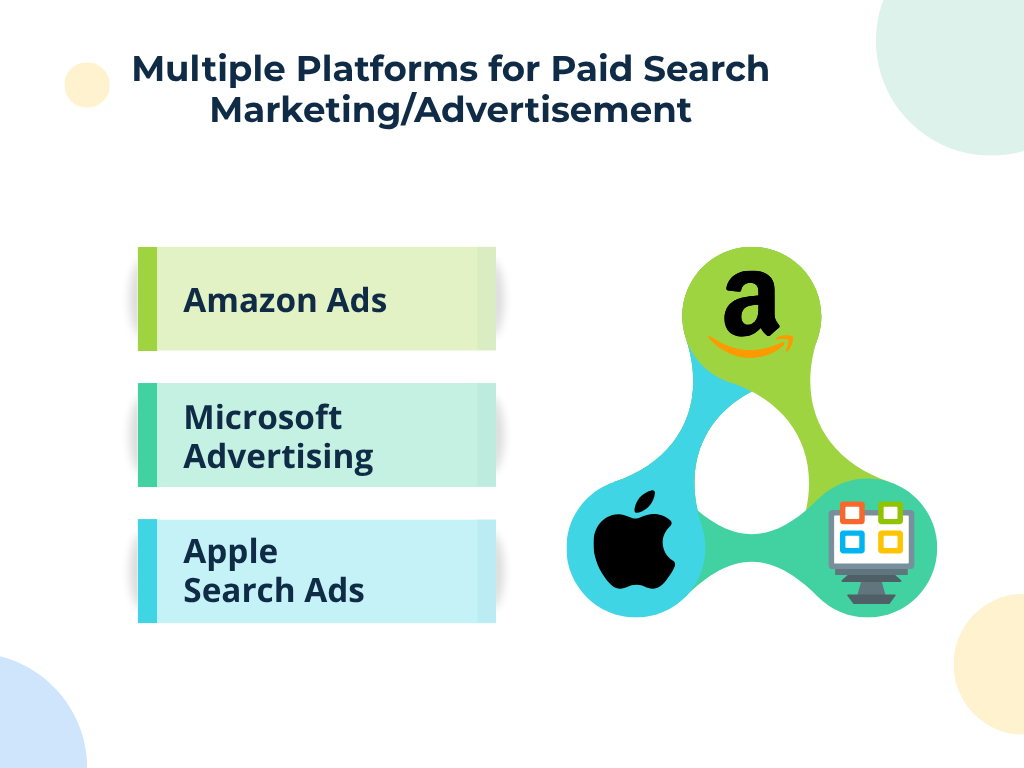
No platform has a monopoly on search. There are four big platforms that make the total global spend exceed $351.5 billion, and 96% of advertisers run search campaigns. A diversified search strategy is required to reach fragmented audiences across various “walled gardens.”
- Amazon Ads: Product Listing Ads (PLAs) play a key role for e-commerce brands. They put product images, pricing, and key details right in front of shoppers at the moment they’re browsing, which makes them highly conversion-focused.
- Microsoft Advertising: This platform gives access to users across Bing, Yahoo, and AOL. It often reaches a more affluent audience, and since competition is typically lower than Google, the cost per click can also be more efficient.
- Apple Search Ads: Designed specifically for app promotion, Apple Search Ads help capture high-intent users directly within the App Store, making it a strong channel for app installs and growth.
How to Launch and Track Campaigns
A well-structured campaign setup ensures both performance and scalability.
Here’s a practical checklist:
- Choose the Right Platform: Match the platform with where your audience actually spends time.
- Set Clear Objectives: Be specific. Ask are you driving sales, leads, or just awareness?
- Structure Your Account: Group campaigns by product or category, and keep ad groups tightly themed.
- Do Keyword Research: Focus on high-intent keywords and actively filter out irrelevant traffic with negative keywords.
- Define Targeting: Lock in location, device preferences, and time schedules based on user behavior.
- Create Relevant Ads: Write clear, compliant copy that directly matches user intent.
- Allocate Budget Smartly: Set daily caps that balance reach with efficiency.
- Set Up Conversion Tracking: Ensure you’re capturing meaningful actions like purchases or sign-ups.
Conversion Tracking: Clicks happen instantly, but real results take time to show. Without proper tracking, it’s easy to mistake activity for performance.
Conversion Tracking
Clicks are immediate, but results are not. So, maintaining patience to drive leads. Meaningful conversion data typically requires 2-4 weeks of optimization.
Start with Manual Bidding to learn and control things while you gather data. Once you have enough conversion history, switch to Automated/AI-driven bidding to get better, real-time results and use advanced technology.
How to Leverage AI/Automation for Ad Campaigns
If you are managing paid search advertising for big brands and large-scale enterprises, then using basic platform tools won’t suffice. Use specialized third-party software to help your team by:
- Connecting Data: Use the built-in Google Gemini to bring together, read, and analyse the data to see a complete picture of your ROI
- Improving Keywords: Fasten and improve your keyword research using tools like Genspark.ai and many more
- Automating Tasks: Instantly running thousands of changes to bids and ads, which can lead to a 50% better Return on Ad Spend (ROAS) compared to doing it manually
Use Audience Targeting, demographics, interests, and past visitors/RLSA on top of their keyword strategy to bid higher for the most valuable users. It helps to get better-quality leads for advertisers.
How to Measure Search Marketing Success
To grow a search marketing campaign, you must look at financial results, not just basic traffic numbers. You need to turn data into smart business decisions. The important metrics to track are given below:
- Impressions: How often your ad is seen.
- CTR (Click-Through Rate): How often people click your ad (shows if the ad is good).
- Conversion Rate: How often a click turns into a customer action (shows if the landing page is effective).
- CPC (Cost-Per-Click): How much you pay for each click.
- CPA (Cost-Per-Acquisition): How much it costs to get one customer/lead.
- ROAS (Return on Ad Spend): The most important metric, the revenue you get back for every dollar spent on ads.
Final Thoughts
Search marketing is a continuous loop: Set Goal → Test Idea → Measure Results → Make Changes
This process ensures your spending is efficient and leads to growth. To succeed in the highly competitive digital landscape, a continuous cycle of setting goals, testing, measuring results, and optimizing is essential. By mastering the nuances of Ad Rank, Quality Score, and strategic components, businesses can leverage Paid Search Marketing to achieve immediate, measurable results and maximize their Return on Ad Spend (ROAS).